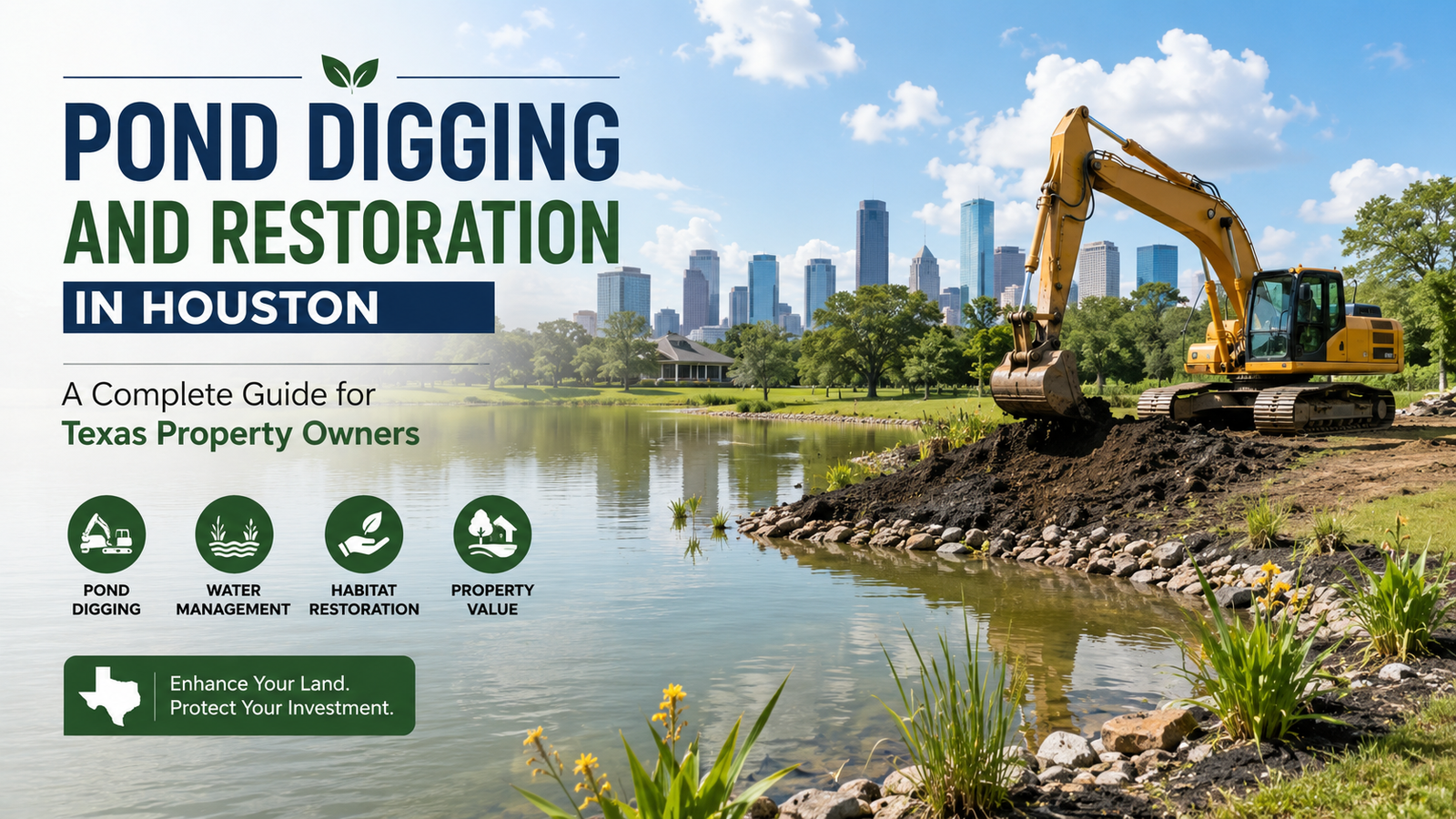
Ponds are a significant and valued feature of the Houston-area landscape. From small residential garden ponds and backyard water features to large agricultural stock tanks, fishing ponds on rural acreage, stormwater detention basins required by municipal regulations, and retention ponds managed by HOAs and commercial developments, water bodies of all types and scales are prevalent across Greater Houston and Southeast Texas. Digging a new Pond Digging And Restoration Houston an existing one both require professional excavation expertise, an understanding of Houston’s distinctive soil and hydrology conditions, and careful attention to regulatory requirements.
Why Houston Is a Pond-Heavy Landscape
Houston’s flat topography and high annual rainfall typically around 50 inches create both the demand and the natural conditions that make ponds viable across the region. The area’s clay soils, while challenging for foundations, are natural pond-sealers: clay’s low permeability is exactly what is needed to retain water in a pond basin. Houston’s rural and semi-rural surroundings the acreage communities of Waller, Montgomery, Fort Bend, and Brazoria Counties support a tradition of stock tanks and recreational fishing ponds that has been part of Texas ranch culture for generations.
The region’s stormwater management challenges have driven widespread construction of detention and retention ponds across the metro area. As Houston has developed, the conversion of permeable land to impervious surfaces has increased runoff volumes. Harris County and the City of Houston require stormwater detention capacity for most significant development projects, resulting in thousands of engineered detention basins across the region.
New Pond Digging in Houston
The process of digging a new pond begins with site evaluation and planning. The contractor assesses the property’s terrain, soil composition, drainage patterns, water source, and intended use to determine the optimal pond location, shape, depth profile, and construction approach. In Houston’s clay-heavy soils, the natural impermeability of the subsoil is a significant advantage many Houston-area ponds do not require synthetic liners because the native clay provides adequate water retention when properly prepared and compacted.
Site preparation precedes excavation. The pond footprint is cleared of trees, stumps, and brush all organic material must be removed from the area to be excavated because organic material left in the pond bed will decompose and create settlement, potential leaks, and water quality problems. The topsoil layer is stripped and stockpiled separately to be redistributed around the pond perimeter after excavation to support vegetation establishment on the banks.
Excavation establishes the pond basin, shaping the design depth profile and bank slopes. A productive fishing pond in Southeast Texas typically aims for center depths of 8 to 12 feet, which maintain water temperature cool enough to support healthy fish populations through Houston’s intense summers. Shallower areas along the banks provide habitat for aquatic vegetation and fish spawning. Gradual bank slopes (3:1 or flatter) are important for vegetation establishment and bank stability steep bank slopes in Houston’s clay soils are prone to slumping and erosion.
Water inlet and outlet management is critical for Houston ponds. An inlet pipe that carries incoming water to the pond in a controlled manner reduces erosion at the water entry point. An overflow or emergency spillway must be designed to safely handle large inflow events given Houston’s rainfall intensity. For stormwater detention basins, the outlet control structure regulates the rate at which stored runoff is released to the downstream drainage system.
Pond Restoration in Houston
Existing ponds naturally accumulate sediment over time. Every rain event washes silt, organic matter, and debris into the pond. Over years and decades, this accumulation reduces pond depth, degrades water quality, promotes excessive aquatic weed growth, and reduces storage capacity a particularly important concern for stormwater detention basins that must meet minimum volume requirements to remain in regulatory compliance.
Sediment removal dredging is the primary pond restoration activity. For most Houston-area ponds, dredging involves drawing down the water level to expose the accumulated sediment layer, then mechanically excavating the sediment with excavators and removing it. The dredged material is typically spread on surrounding land as fill or pushed to a designated disposal area well away from the pond edge to prevent it from washing back in.
Bank erosion repair is another common restoration need for Houston ponds. The clay slopes that form pond banks are susceptible to erosion from wave action, water level fluctuation, and rain impact particularly when vegetation cover has been lost or never properly established. Restoration involves reshaping eroded banks to proper slope angles, stabilizing the soil surface with appropriate erosion control measures, and replanting bank vegetation to provide long-term root-zone stabilization. For stormwater detention basins in Harris County and the City of Houston, regulatory compliance is an active concern these facilities must maintain their as-built capacity and stable, vegetated slopes.
Common Questions About Pond Digging and Restoration in Houston
Does a new pond in the Houston area require permits? Permit requirements vary depending on pond size, location, and purpose. Ponds that intercept waterways or wetlands may require permits from the Army Corps of Engineers and TCEQ. Agricultural ponds on rural land typically have fewer regulatory requirements. A contractor experienced in Houston-area pond construction can advise on the specific requirements for your project.
How often should a Houston pond be dredged? The dredging interval depends on the pond’s watershed size, land use, and the rate at which sediment is entering the pond. A depth survey comparing current depths to the original design dimensions is the most reliable way to assess when dredging is needed.
Can fish be preserved during pond dredging? Yes, with proper planning. Most dredging projects involve a partial water drawdown rather than complete drainage, allowing fish to congregate in deeper water while shallow areas are worked.